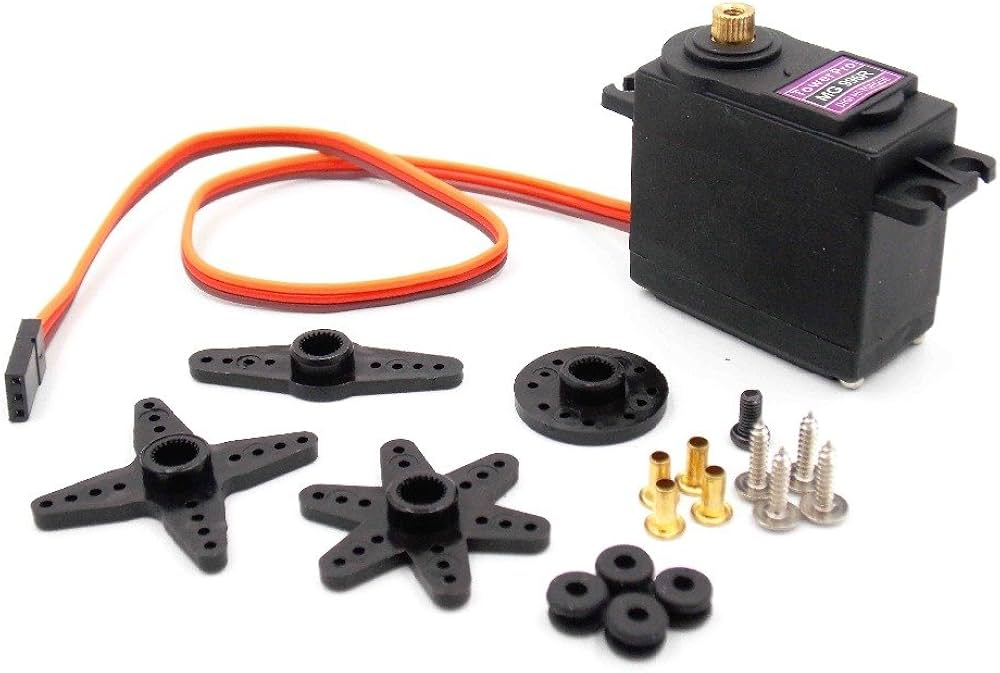
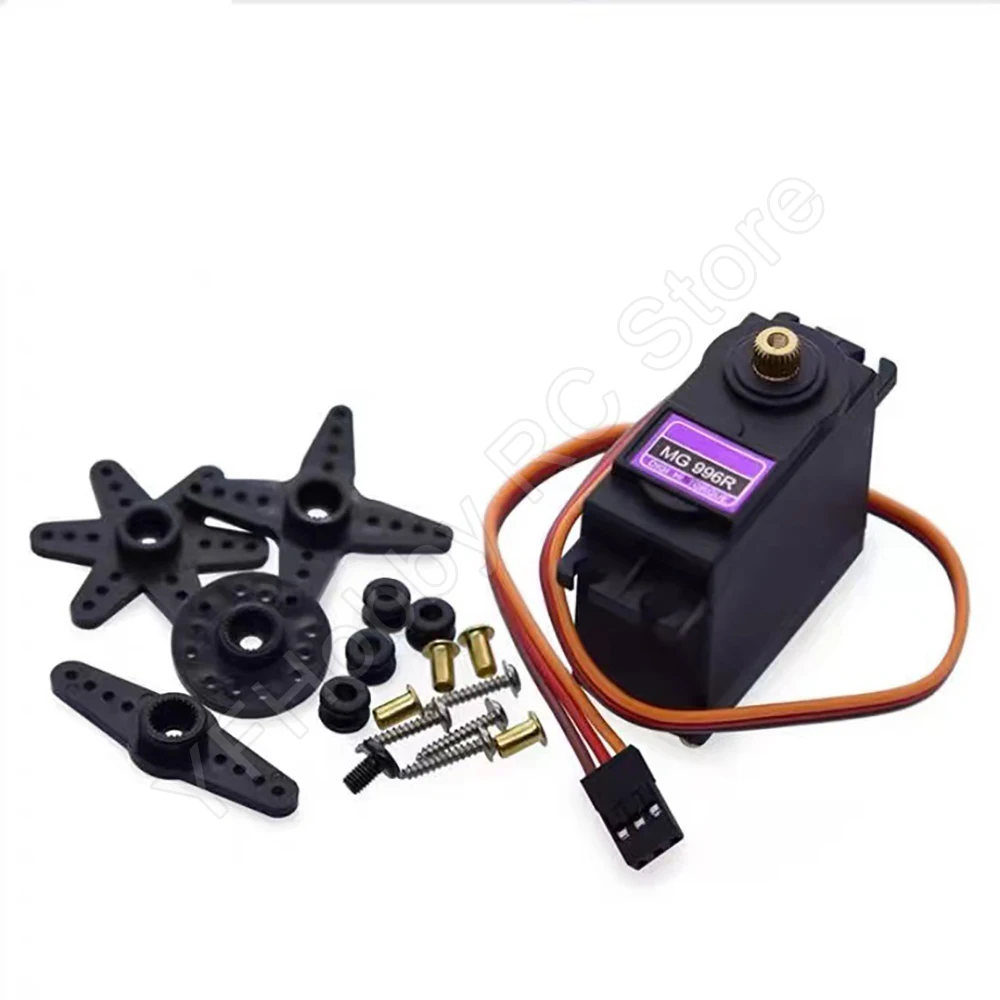


 MG996 Servo 360 Overview
- Type: Continuous rotation servo motor.
- Functionality:
- Continuous Rotation: Unlike standard servos, which are limited to about 180 degrees of rotation, the MG996 Servo 360 is designed for continuous 360-degree rotation.
- Speed Control: Instead of controlling position, it controls the speed and direction of rotation.
- Specifications:
- Operating Voltage: 4.8V to 7.2V.
- Stall Torque:
- 9.4 kg-cm (at 4.8V)
- 11 kg-cm (at 6.0V)
- Speed:
- 0.17 sec/60° (at 4.8V)
- 0.13 sec/60° (at 6.0V)
- Dimensions: 40.7mm x 19.7mm x 42.9mm.
- Weight: Approximately 55 grams.
- Gears: Metal gear train for enhanced durability and strength.
- Features:
- Metal Gears: Provides increased strength and reliability, making it suitable for high-stress applications.
- High Torque: Capable of delivering high torque, making it ideal for applications requiring significant force.
- Durability: Robust design and materials ensure long-lasting performance.
Typical Uses:
- Robotics: Commonly used in mobile robots for driving wheels or other continuous motion tasks.
- RC Vehicles: Suitable for driving wheels in remote-controlled cars, boats, and other vehicles.
- Automation Projects: Used in various DIY and professional automation projects requiring continuous rotation motors.
Key Benefits:
- High Torque and Durability: Metal gears and high torque output make it suitable for demanding applications.
- Versatile Applications: Continuous rotation capability expands its use beyond traditional servo applications.
- Simple Control: Controlled using standard PWM (pulse-width modulation) signals, compatible with most microcontrollers and RC systems.
Example Applications:
- Mobile Robots: Used to drive wheels, providing forward, backward, and turning movements.
- Conveyor Systems: Drives conveyor belts in small-scale automation setups.
- Pan and Tilt Systems: Creates continuous rotation for panoramic camera systems.
How to Use:
- Connect to Microcontroller: Connect the signal, power, and ground wires to the appropriate pins on your microcontroller or RC receiver.
- Signal Wire (usually orange or white): Connects to the PWM output pin.
- Power Wire (usually red): Connects to a voltage source (4.8V to 7.2V).
- Ground Wire (usually black or brown): Connects to the ground of the power source and microcontroller.
- Write Code: Use PWM signals to control the speed and direction of the servo.
- Center Position (1500 microseconds): Stops the servo.
- Lower Pulse Width (<1500 microseconds): Rotates in one direction (the smaller the pulse width, the faster the speed).
- Higher Pulse Width (>1500 microseconds): Rotates in the opposite direction (the larger the pulse width, the faster the speed).
- Test and Adjust: Test the servo's operation and adjust the PWM signals to achieve the desired speed and direction.